Financing & Investment
Real Estate Leverage: Boosting Your Investment Returns
Or: how to use a mortgage in Portugal the right way
Ola Labunets · Updated: 4 September 2026 · 6 min read
The short version
- Leverage = buying a more expensive property using relatively little of your own capital, plus a mortgage.
- The higher the leverage, the higher both the potential return and the risk.
- A mortgage in Portugal for foreign investors requires an individual eligibility check upfront.
- Before you leverage up, check your monthly cash flow, not just the return on paper.
What is real estate leverage?
Real estate leverage is a technique that lets you buy higher-value properties using relatively little of your own capital. You do this by taking out a loan (usually a mortgage) to finance most of the property's cost. As a result, you can buy more properties and significantly increase your return on investment.
Not sure how it works in practice? You can read more in our Mortgages in Portugal guide.
An example of real estate leverage
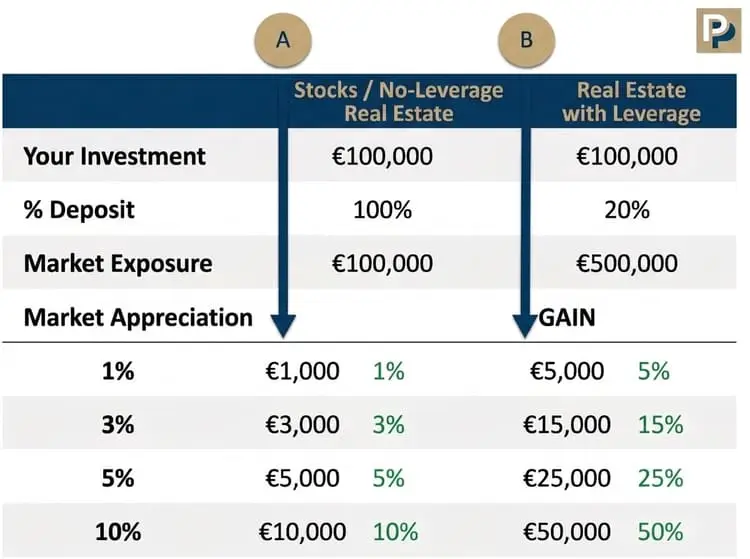
Say you have €100,000. In Case A, that amount is invested in the stock market (or real estate), unleveraged. In Case B, the same amount is used as equity for a leveraged real estate purchase (with a mortgage), i.e. buying a property worth far more than €100,000.
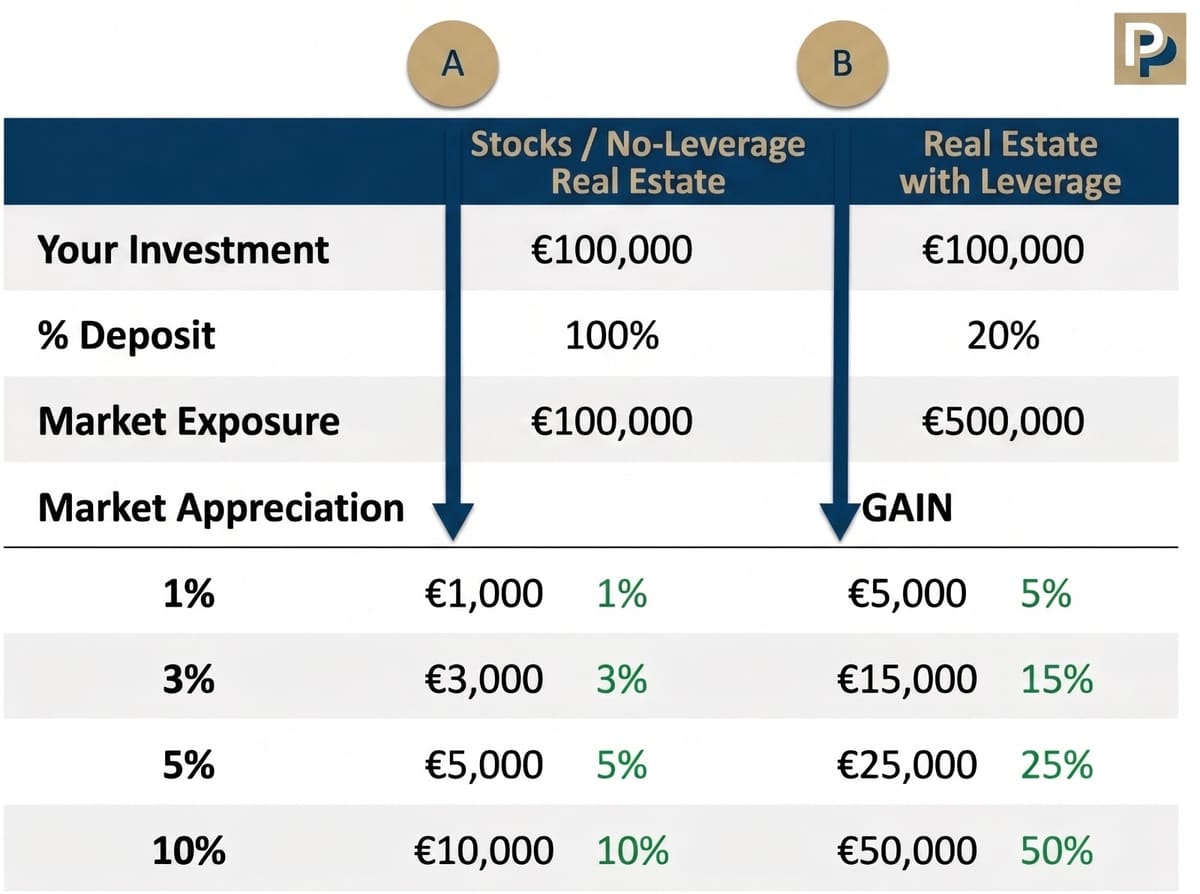
Now try it yourself: drag the sliders below to see how your capital, deposit percentage, and yield affect gross profit between the two alternatives.
The higher the leverage, the higher the potential return. That said, higher leverage also increases risk, since loan interest payments can weigh on your monthly cash flow. The comparison above shows gross profit only, before financing costs.
Advantages of real estate leverage
Higher returns: Leverage can significantly increase the return on your real estate investment.
Access to pricier properties: With leverage, you can buy more expensive properties that might not otherwise be within reach.
Faster portfolio growth: Thanks to the higher return, you can build capital faster and acquire additional properties sooner.
Disadvantages of real estate leverage
Increased risk: As mentioned, higher leverage increases risk. If the property's value drops, you may struggle to meet loan payments and be forced to sell at a loss.
Dependence on loans: Leverage makes you dependent on borrowing. If interest rates rise, loan payments can grow and weigh on your monthly cash flow.
More complexity: A leveraged real estate investment can be more complex than an all-cash purchase, including securing a mortgage and managing multiple payments.
Bottom line
Real estate leverage can be a powerful tool for boosting returns from real estate investment. That said, it needs to be used carefully, with full awareness of the risks involved. Before leveraging into a real estate investment, do thorough research and consult with a qualified professional.
Want to estimate your monthly payment before going further? Start with our mortgage calculator and get an initial estimate in minutes.
Want to check how much you could leverage? Check your mortgage eligibility in Portugal, or book a personal consultation before you move forward.
Frequently Asked Questions
Is a mortgage in Portugal available to foreign, non-resident investors?+
Yes. Portuguese banks do offer mortgages to foreign investors, but terms (loan-to-value, interest rate, required documents) vary by bank and by your personal profile. An individual eligibility check is the reliable way to know what applies to you.
Is leverage suitable for a beginner investor?+
Leverage can work for beginner investors too, but because of the added risk (dependence on loan repayments, sensitivity to a drop in value) it's especially important to start with professional guidance rather than relying on a gross-return calculation alone.
What is the difference between leverage and an all-cash purchase?+
An all-cash purchase is simpler and carries no loan dependency, but it 'locks' a large amount of capital into a single property. Leverage spreads that same capital across a larger property (or properties), at the cost of depending on monthly mortgage payments.
How do you know how much to leverage?+
The answer depends on your monthly cash flow, income stability, and the worst-case scenario (what happens if actual returns come in below forecast, or if interest rates rise). That is exactly why it is worth running the numbers with a professional before signing anything.
First published: 4 September 2026